Determining which assets and securities to trade holds immense significance, and this decision must be intricately tied to your risk aversion. Novices often fixate on a single market or security, yet diversifying your portfolio serves as an effective strategy to mitigate risk and avoid sole reliance on the performance of a solitary security.
Asset Allocation
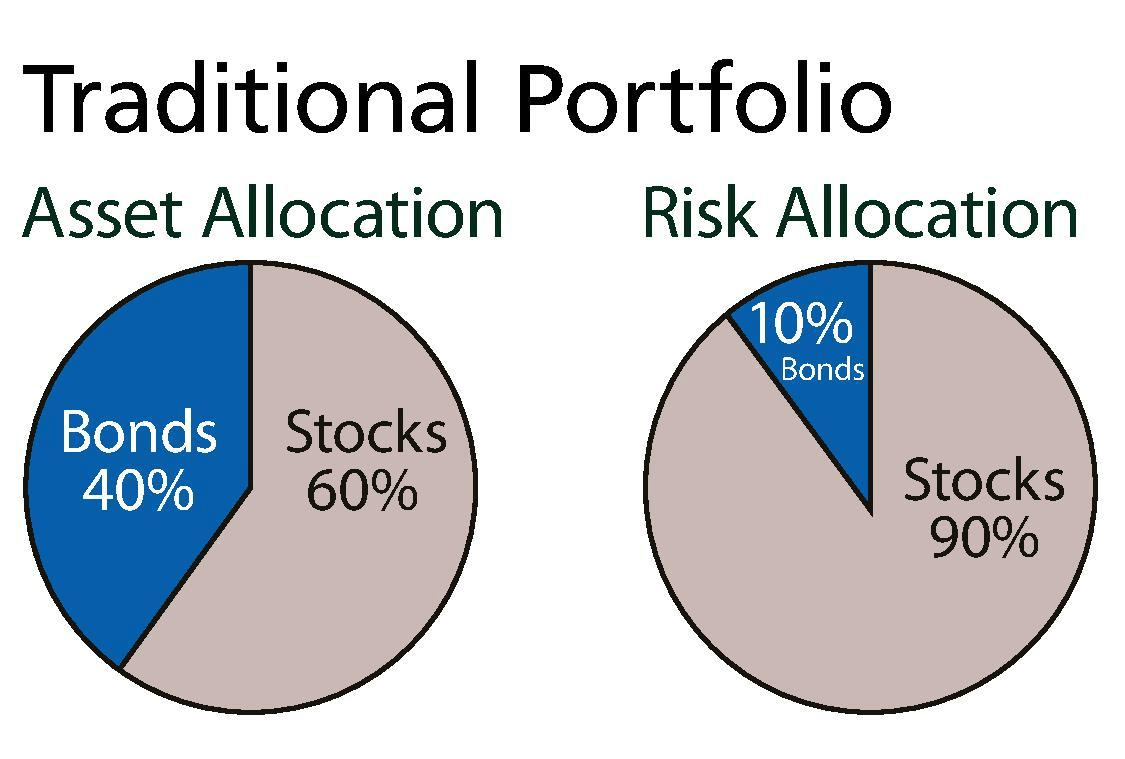
Creating a portfolio that spans diverse assets empowers an investor to manage risk. Through asset allocation, you can blend different classes like stocks, commodities, and bonds.
Incorporating less risky assets into your portfolio might yield lower potential returns but substantially curbs risk. For instance, a portfolio entirely composed of stocks carries more risk than one combining 60% stocks and 40% bonds, though the latter boasts the prospect of heightened returns.
The most suitable asset allocation hinges on your trader profile. Aggressive traders may lean towards a minimal portion of low-risk assets or none at all. On the other hand, conservative traders prioritize secure assets. Common asset allocations involve dedicating over 50% of assets to speculation, with less than half earmarked for generating fixed income.
Security Selection
Certain traders might specialize in speculative assets or concentrate solely on a specific market. Nonetheless, diversification remains attainable. Even within the realm of stock trading, a trader can manage a portfolio comprised of a diverse array of stocks.
Selecting appropriate securities is paramount. A steadfast guideline is to opt for liquid securities, as they translate to reduced transaction costs and swifter order execution.
For effective diversification, choose securities with minimal correlation. Correlation, represented on a scale of -1 to 1, signifies the relationship between two securities. A correlation of 1 indicates a perfect positive correlation, where prices tend to move in sync. Conversely, -1 denotes a perfect negative correlation, signifying opposing price movements. A correlation of 0 signifies no discernible connection between securities.
Modern Portfolio Theory
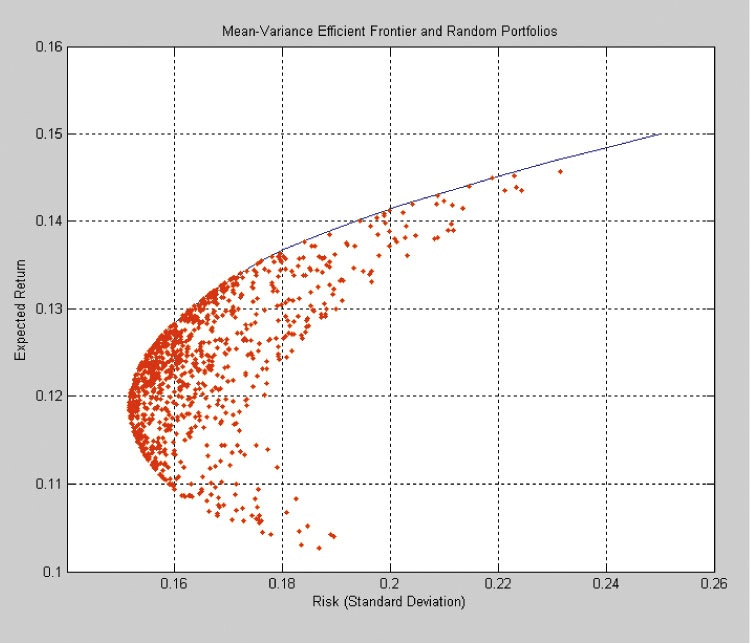
Efficient frontier in blue
The Modern Portfolio Theory (MPT) outlines how an investor can craft optimal portfolios within a specific risk tolerance.
Selecting an optimal portfolio involves plotting the expected return against portfolio risk. The portfolio offering the highest return at a designated risk level is deemed optimal. This process generates a collection of optimal portfolios, collectively forming the efficient frontier for each risk level.