Constructing a portfolio stands as the initial endeavor for most traders, and this procedure transcends the mere selection of tradable assets. The foundation of a sound portfolio hinges on the identification of your trader profile, a task facilitated by addressing pivotal inquiries:
- What constitutes your initial capital?
- What level of return are you targeting?
- How averse are you to risk?
- What is your investment horizon?
- What amount of time can you dedicate?
These queries interrelate, rendering harmonious responses a challenge. The subsequent sections expound upon the essence of each query, aiding in the identification of your trader profile.
Initial Capital
Determining your investable capital is of paramount significance. While varied questions could unveil this value, a simplified approach will suffice. Low capital wields diverse implications, directly correlating to buying power. Diminished buying power curtails access to specific assets and impairs portfolio diversification, amplifying risk. Leverage augments buying power but escalates risk.
Limited capital might curtail your portfolio's longevity, conflicting with your investment horizon goal. Certain markets favor traders with modest capital, exemplified by the forex and cryptocurrency markets, which offer elevated leverage compared to stocks.
Risk/Returns
Risk and returns share an interconnected dynamic: higher returns entail higher risk. Gauging your risk aversion is pivotal for constructing an effective portfolio, aligning this choice with other facets of your trader profile. Financial instruments exhibit varying risk/return ratios, warranting thoughtful selection based on your profile. A balanced mix of instruments can mitigate risk, such as a portfolio comprised of 60% derivatives and 40% bonds.
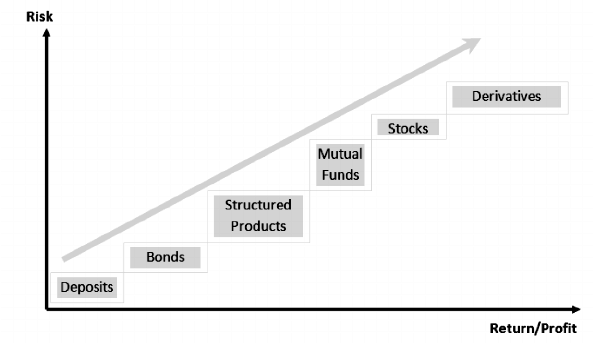
Comparison of the risk profile and return rate of various financial instruments [1]
Investment Horizon
Your investment horizon exerts significant influence over your trading journey. Long-term traders opt for holding positions for years, employing the buy-and-hold strategy. Others engage in "swing-trading," where positions span days to months. "Day-traders" execute positions within a single trading day, with scalpers, a subset of day-traders, holding positions for mere minutes.
Though many beginners gravitate towards day-trading and scalping, it's crucial to acknowledge that shorter investment horizons entail challenges. Short-term trading demands precision in timing and yields smaller profits, encouraging higher leverage and amplified risk. Multiple positions translate to increased frictional costs, which impact profit margins more significantly for smaller gains.
Scalping is discouraged for beginners.
Availability
Trading necessitates dedicated time and effort, even in automated scenarios. However, varying levels of available time exist among traders. Essential tasks encompass:
- Monitoring existing positions
- Executing Orders
- Conducting Research
Traders with ample time can craft sophisticated portfolios and undertake shorter-term trades. In contrast, those with limited time gravitate towards longer-term trading like swing trading.
These sections aim to provide traders with valuable insights into distinct trading facets, assuming a foundational grasp of core concepts like order types and trade executions.
References
[1] PAŠkEviČiuS, Arvydas, and Ovidijus SAČilkA. "Structured securities and their development in Lithuania." Ekonomika 89.4 (2010): 101-114.